
Coffee County Arrest Report Archive
The Coffee County Sheriff Press archive is the county's best official source for arrest narratives that stretch across days. Each card shows a date, author, category tag, headline, and short description. Stories may name the agencies involved. They can also describe charges and context. An Older Posts control pages back through earlier entries. Still, this is not a jail ledger. The sheriff picks which matters earn a public story. A post may follow a warrant service, a seizure, or a joint operation rather than the booking itself, so a missing story never means no arrest happened. Treat an article's date as a publication date, never a booking date, unless the story says otherwise.
The official older-posts view demonstrates the archive's depth.

The sheriff's press archive displays a browsable narrative history rather than a dated roster of everyone booked.
Read Coffee County Arrest Narratives
Start with the official archive and work outward. Keep the post date and event dates apart. When several agencies took part, note which one made the arrest, which investigated, and which office holds the record now.
- Open the sheriff Press archive and note the date, headline, author, and category.
- Read the full story for the alleged event date, arresting agency, stated charge, and custody destination.
- Check whether the article uses a presumption-of-innocence notice and preserve charge-level wording in your notes.
- Use the sheriff app for current Coffee custody. For today's unreported bookings, use Arrested Today.
- Follow a filed case through Coffee State or Superior Court via Georgia Courts eAccess and PeachCourt, as appropriate.
One post can cover several people or events. A later post may update an earlier investigation. Search with spelling variations, then compare dates and agencies before treating two references as the same case.
Coffee Arrest Report Fields
Press cards give narrative fields, not booking columns. Record only what the source states plainly. A photo or headline alone will not tell you a bond amount, a photo policy, or where a person is held.
| Report detail | What it establishes |
|---|---|
| Publication date | When the sheriff released the story, which may differ from the arrest date. |
| Headline and category | The agency's summary and topic grouping, not a formal court finding. |
| Named agency | Who investigated, arrested, assisted, or received a transfer, as stated. |
| Alleged charge | The charge reported at that stage; it may later change. |
| Event location | The place described in the story, which may not be the booking site. |
| Image | A selective press illustration, not proof of a universal mugshot feed. |
A booking number may be missing. Bond amounts and release dates may be missing too. Get those details from the jail, the records custodian, or the court rather than an unofficial listing.
Why Coffee Arrest Posts Differ
Coffee County's specialty units shape the archive's uneven coverage. The sheriff runs a Drug Unit, K-9, Aviation, SWAT, Investigations, and Patrol. Multi-agency cases may pull in city police, the Georgia Bureau of Investigation, the Georgia Department of Corrections, or another county. Those matters tend to get detailed stories. Routine bookings rarely do. The archive is a strong enforcement narrative but a poor crime denominator. Ten stories do not mean ten arrests. One post with several defendants still counts as one. A single investigation can spawn updates for months, and post counts should never be combined with arrest statistics. The official first-100-days article shows the format of an attributed operational report.
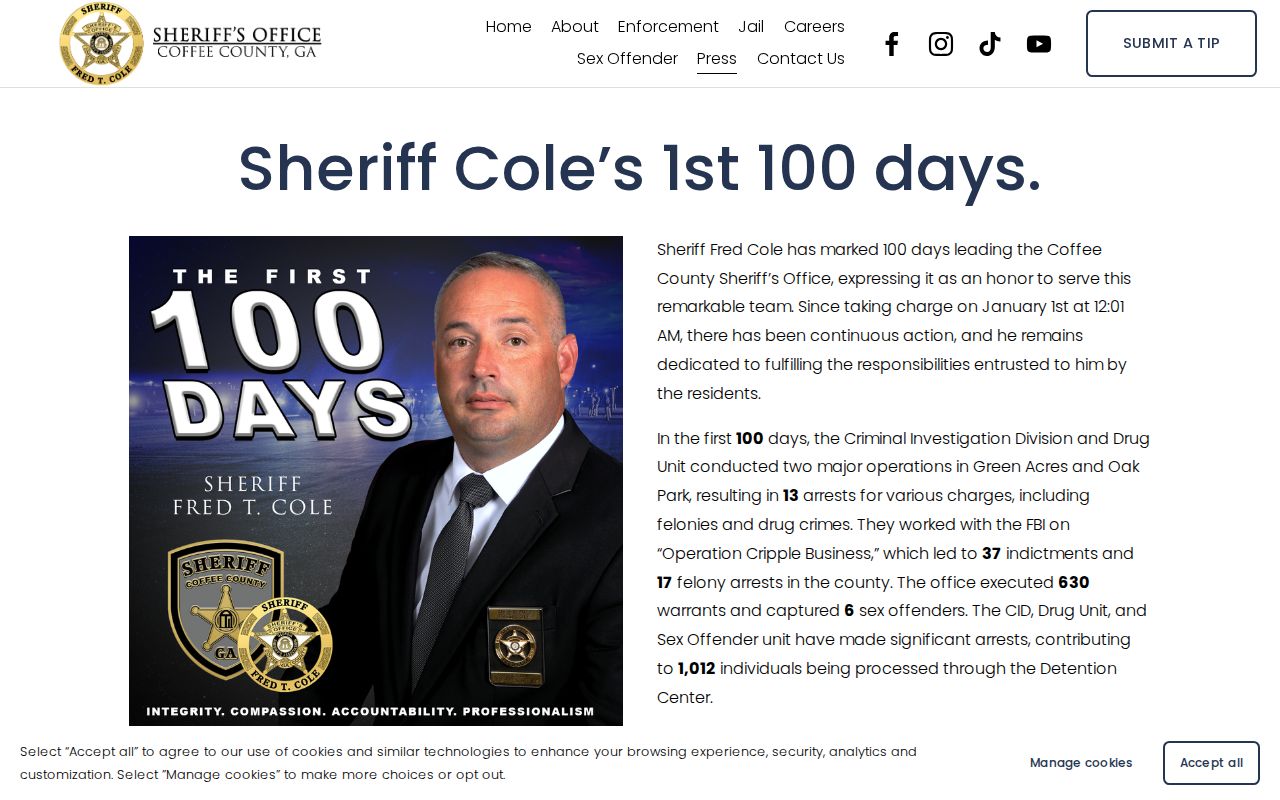
The page demonstrates how an agency summary differs from a person-by-person booking log.
Weekend Coffee Arrest Reporting
Weekend timing creates a verification problem, not a crime surge. An arrest late Friday may be booked, released, or moved before the office reopens. A sheriff story can lag days behind the event. Court filing runs on its own schedule. Keep those clocks separate. For any weekend arrest, track the incident date, the stated arrest date, the booking time if the jail provides one, the story date, and the court filing date. If only the story date is known, label it that way. Never turn it into a booking timestamp.
The county app tracks current custody. Someone released earlier may not appear there. For every booking in a past weekend, a bounded open-records request is the stronger route.
Local Coffee Arrest Coverage
News coverage can fill the gaps. Once official sources end, WALB keeps a Coffee local-news topic page going. Douglas Now publishes reports on work by city police, the sheriff, or state agencies. The Georgia Gazette keeps a Coffee County archive. None of these is a county booking system. The WALB Coffee topic page shows its dated local-news structure.
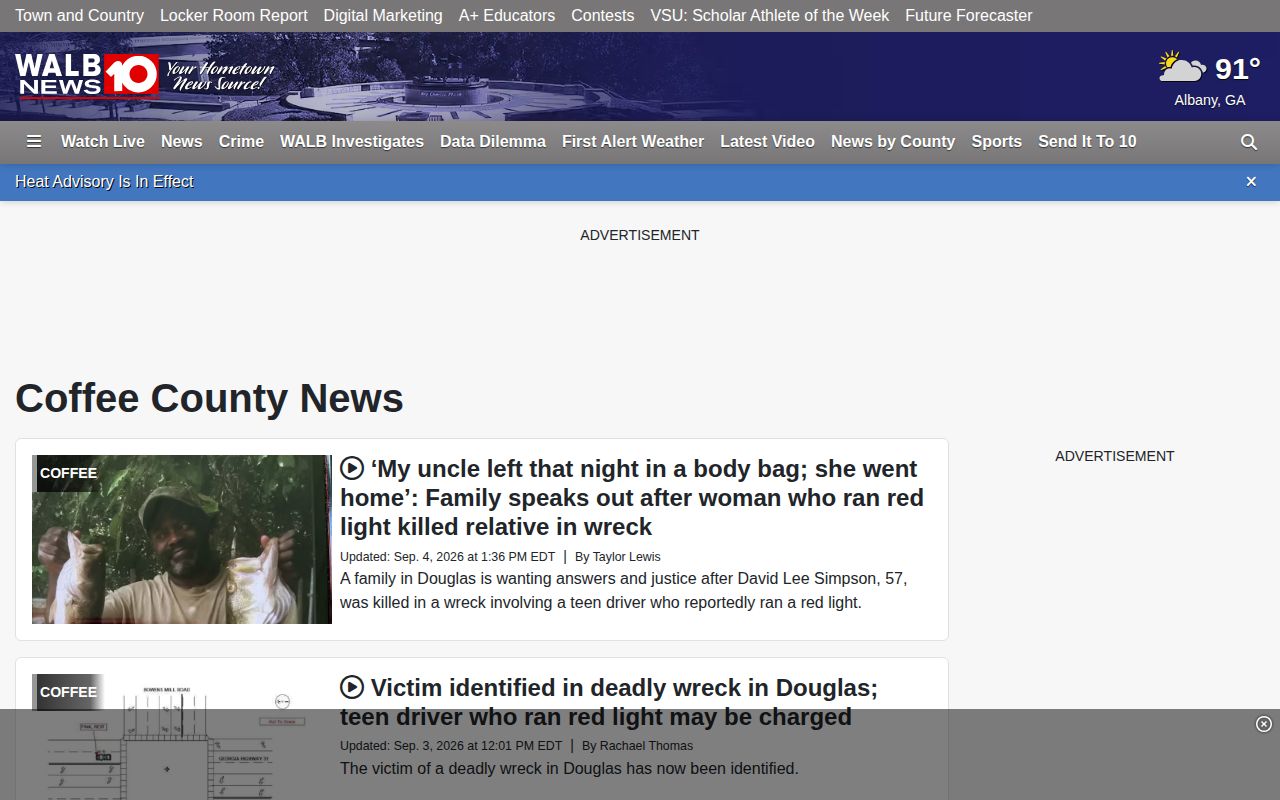
A news search helps, but every custody fact still needs confirmation from the sheriff, the jail, or the court. Unofficial reports can be stale or selective. Some get corrected later. Compare the named agency and event date against the official record before trusting a match.
Coffee Arrest Archives and Retention
Coffee County keeps its arrest history in layers, and the layers age at different speeds. The public Press archive runs back through prior months. That visible depth is a convenience, not a promise. Georgia's Archives schedule for local governments sets jail booking records at ten years after release. Jail registers stay ten years after the last entry. Hold records, transfer files, and investigation logs follow their own schedule periods. A retention category, though, never guarantees every field is public or still held by Coffee County.
Need something older than the Press pages show? Send a written request through CCSO Open Records and its NextRequest route. Name the record, the person, the agency, and a narrow date range. Ask for a cost estimate up front. The office may redact protected material or explain why a record is unavailable.
An arrest is only the first chapter. The court docket tells how the case ends. A charge may be dropped before filing. It may also be reduced, dismissed, resolved by plea, or taken to trial.
Note: Archive depth, search behavior, and retention are separate facts; verify each with the office that created the record.